
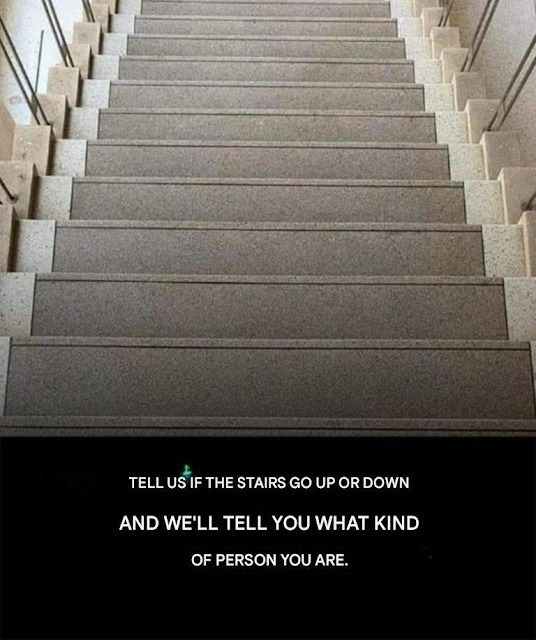
Our brains tend to favor the **simplest interpretation** of visual information. This is known as the principle of **pragnanz**, a Gestalt psychology rule which states that people perceive complex images in the simplest form possible. In the case of the ladder, your brain may initially pick one direction that “makes sense” before possibly flipping to the other.
#### **2. Perception is Active, Not Passive**Seeing a ladder going up or down shows that **vision isn’t just about detecting light**—it’s about interpretation. Your brain constantly makes assumptions based on context, angles, and prior knowledge. Optical illusions reveal the assumptions your brain makes, often subconsciously.
#### **3. Ambiguity Sparks Curiosity**
Ambiguous images like the ladder grab our attention because they **challenge our cognitive expectations**. They trigger curiosity and engagement, as the brain tries to resolve the conflicting information. This is why optical illusions are not only entertaining but also educational.
### **Can You Train Your Brain to Switch Perspectives?**
Interestingly, many people can learn to switch between seeing the ladder as ascending or descending. This requires a combination of **attention, visualization, and mental flexibility**:
1. **Focus on the Opposite End:** If you initially see it going up, focus on the bottom of the ladder and imagine it descending.
2. **Adjust Your Angle:** Mentally rotate the image or imagine yourself standing at the top looking down.
3. **Practice Mindfulness:** Slowing down and observing details can make it easier to notice alternative interpretations.
With practice, you can experience the ladder flipping back and forth at will—an entertaining exercise in mental agility.
