
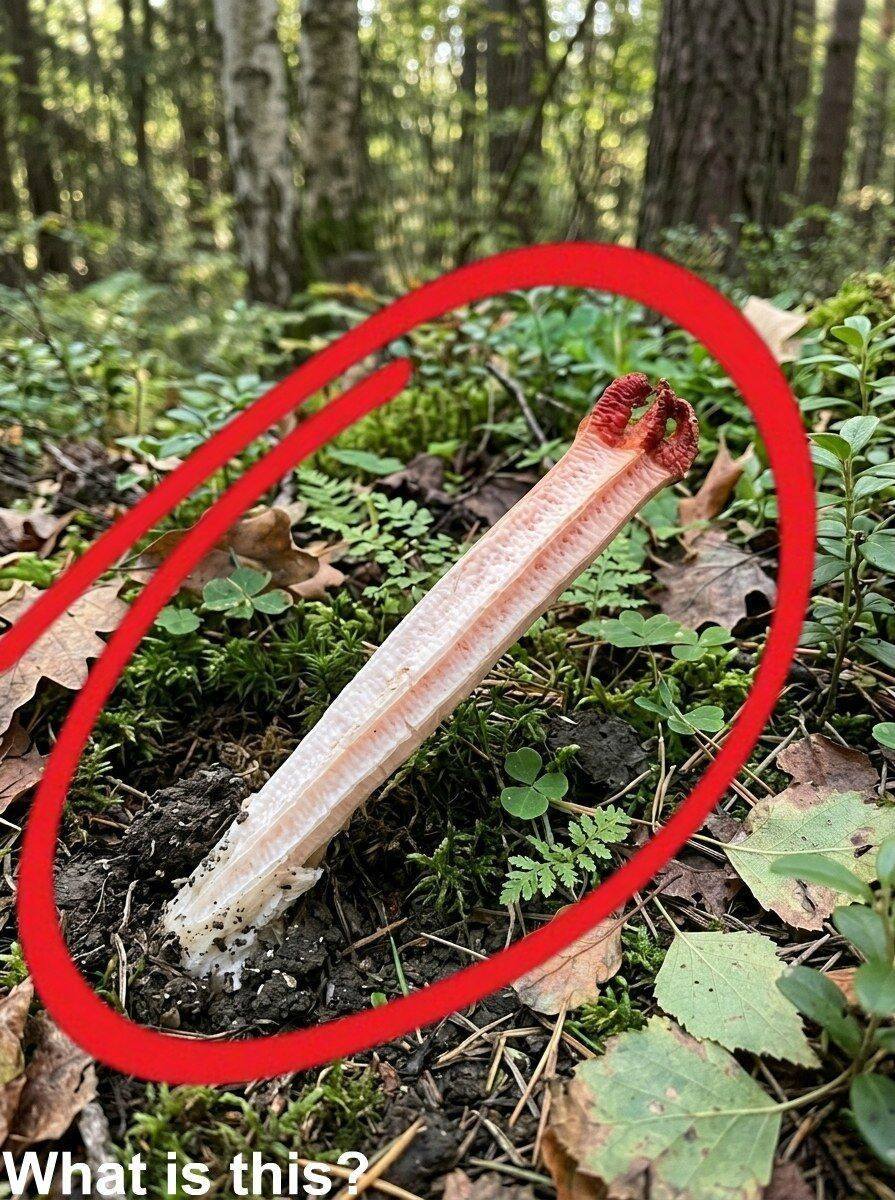
The red projections resembled bloody fingers so convincingly that I could hardly believe it was natural.
For a brief moment, I genuinely wondered whether I had stumbled upon evidence of something terrible.
My hands trembled slightly as I reached into my pocket and pulled out my phone.
The bright screen felt strangely comforting against the dark forest backdrop.
I crouched several feet away from the object and began searching for answers.
My fingers moved quickly across the keyboard.
“Red hand-shaped fungus.”
“Bloody fingers growing from ground.”
“Red tentacle mushroom with bad smell.”
Within seconds, images began appearing on the screen.
And then I found it.
The answer.
The bizarre object wasn’t a hand.
It wasn’t a corpse.
It wasn’t evidence of some horrifying crime hidden deep in the woods.
It was a fungus.
A very unusual fungus.
Scientifically known as Clathrus archeri.
More commonly known as Devil’s Fingers.
I stared at the photographs in disbelief.
Every image matched exactly what sat before us.
The strange red arms.
The fleshy appearance.
The disturbing smell.
Everything.
According to the information I found, Devil’s Fingers begin their lives hidden inside a gelatinous egg-like structure buried in the soil. When mature, the egg splits open and several bright red tentacles burst outward, creating the terrifying appearance of fingers emerging from the ground.
The smell had a purpose too.
That foul odor wasn’t accidental.
The fungus intentionally mimics the scent of rotting flesh.
By doing so, it attracts flies and other insects.
Those insects land on the fungus, collect its spores, and unknowingly spread them elsewhere.
Nature had essentially created a living deception.
A fungus that pretended to be death in order to reproduce.
The realization was almost as fascinating as it was unsettling.
The fear that had gripped my chest suddenly dissolved.
Relief rushed through me.
Then I laughed.
A nervous, shaky laugh at first.
Followed by a genuine one.
The tension that had built inside me for several minutes finally released.
Leo looked up.
“Why are you laughing?”
I smiled.
“Because it isn’t dangerous.”
He frowned.
“What is it?”
“It’s a mushroom.”
His eyes widened.
“A mushroom?”
I nodded.
“A very weird mushroom.”
Slowly, his fear transformed into curiosity.
We both crouched near the fungus, keeping a respectful distance while studying it more carefully.
Now that we knew what it was, it seemed less frightening and more extraordinary.
The bright red arms curved outward like something from another planet.
Tiny insects crawled across its surface.
The structure looked alien.
Impossible.
Yet completely natural.
“Nature is strange,” Leo said.
I laughed.
“Sometimes very strange.”
For several minutes we observed the fungus, discussing how something so bizarre could exist in the same forest where squirrels, birds, and deer lived.
The more we learned, the more fascinated we became.
What had initially looked like a nightmare was actually one of nature’s most remarkable creations.
Eventually, we stood and continued along the trail.
The forest felt peaceful again.
But the experience stayed with me.
Every so often, I found myself glancing back toward the place where the Devil’s Fingers stood among the leaves.
Not out of fear.
Out of fascination.
The encounter served as a powerful reminder that nature is filled with surprises waiting just beyond our expectations.
Sometimes those surprises are beautiful.
Sometimes they are unsettling.
And occasionally they are both at the same time.
What began as an ordinary family hike became a story neither of us would ever forget. A simple walk through the woods had transformed into an encounter with one of the strangest organisms either of us had ever seen. And long after we left the forest behind, I kept thinking about that crimson shape emerging from the earth—a reminder that even in places we think we understand, the natural world still hides mysteries capable of astonishing, frightening, and inspiring us all at once. :contentReference[oaicite:0]{index=0}
