
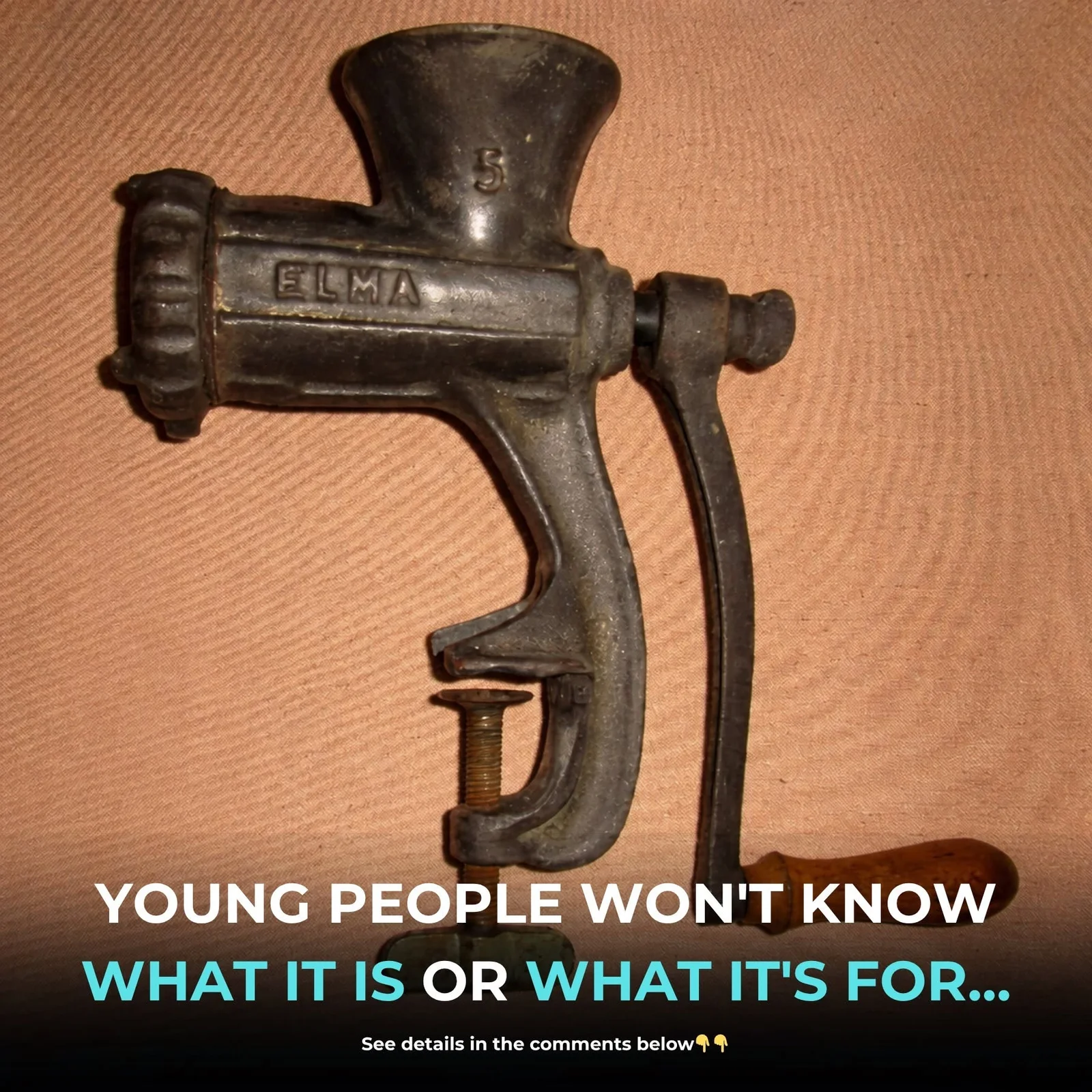
The Mysterious Metallic Object That Left the Internet Guessing: Could You Identify This Forgotten Tool?
Every now and then, an unusual photograph appears online and captures the curiosity of thousands—sometimes even millions—of people. The image might show an old metal device with strange handles, gears, hooks, or moving parts that seem impossible to identify at first glance.
Comments quickly begin to pour in.
“Is it a medieval torture device?”
“A kitchen gadget?”
“An old medical instrument?”
“Some kind of farming equipment?”
The guesses become increasingly creative, and before long the mysterious object has become an internet sensation.
These forgotten artifacts fascinate us because they offer a glimpse into a time when everyday tools looked completely different from the sleek, electronic devices we use today.
So why do these mystery-object challenges become so popular, and what can they teach us about history, technology, and human curiosity?
Let’s explore.
Why Vintage Objects Seem So Confusing Today
Modern products are usually designed with simplicity in mind.
Most gadgets have:
Digital screens
Clearly labeled buttons
Simple controls
Familiar shapes
Older tools were often built very differently.
Many were made entirely from cast iron, steel, brass, or wood.
They featured gears, springs, hinges, screws, levers, and mechanical parts that performed highly specialized tasks.
Without knowing the historical context, it’s almost impossible to guess their purpose correctly.
That’s why so many antique objects puzzle modern audiences.
Every Profession Had Specialized Tools
Today, many jobs rely on computers and electronic equipment.
A century ago, nearly every profession depended on unique hand tools.
Blacksmiths had equipment unfamiliar to tailors.
Cobblers used tools unlike those of carpenters.
Barbers, doctors, farmers, watchmakers, jewelers, printers, and bakers all relied on instruments designed specifically for their trades.
If one of these tools appears online without explanation, most people have little chance of recognizing it.
Why the Internet Loves Mystery Objects
There is something irresistible about a puzzle.
When we don’t immediately know the answer, our brains naturally begin searching for clues.
People examine:
The shape
The size
Moving parts
Materials
Wear patterns
Handles
Hinges
Sharp edges
Every detail becomes a potential clue.
Soon the comment section fills with theories ranging from surprisingly accurate to hilariously imaginative.
Some guesses are based on logic.
Others are inspired by movies or historical fiction.
Part of the fun comes from comparing ideas before the real answer is revealed.
Looking Closely at the Clues
When historians identify antique tools, they rarely rely on appearance alone.
Instead, they ask several questions.
What Material Is It Made From?
Heavy cast iron often suggests industrial use.
Brass may indicate scientific or precision equipment.
Wooden handles usually point toward hand-operated tools.
Does It Move?
If the object contains gears or hinges, it likely performed a mechanical function.
Moving parts often reveal how force was applied during use.
Are There Signs of Wear?
Polished areas may indicate where hands repeatedly held the tool.
Scratches might reveal contact with specific materials such as leather, metal, or wood.
How Large Is It?
Tiny tools often belonged to jewelers or watchmakers.
Larger devices may have been used in farming or manufacturing.
Each clue helps narrow the possibilities.
Common Objects People Frequently Misidentify
Many antique tools repeatedly confuse internet users.
Examples include:
Butter molds
Ice tongs
Buttonhook tools
Boot jacks
Apple peelers
Sewing devices
Grain scales
Hand drills
Pipe cutters
Corn shellers
Without context, these objects can look completely mysterious.
Yet each once played an important role in everyday life.
The Evolution of Everyday Technology
One reason these objects appear strange is that technology has changed dramatically.
Tasks once requiring large mechanical devices can now be completed with:
Electric motors
Computers
Plastic components
Digital controls
Automated machinery
As technology evolved, countless older tools disappeared from daily use.
Entire generations grew up without ever seeing them.
Eventually, their original purpose faded from public memory.
Why Mechanical Design Was So Ingenious
Older tools may appear complicated, but many were brilliant examples of engineering.
Before electricity became widespread, designers relied entirely on:
Leverage
Springs
Pulleys
Ratchets
Gears
Counterweights
Every movement had to be generated by human effort.
As a result, inventors created remarkably efficient mechanisms using only simple materials.
Many antique tools continue functioning today despite being over a century old.
The Rise of Online Antique Communities
The internet has created communities dedicated to identifying mysterious objects.
Collectors, museum volunteers, historians, engineers, and antique enthusiasts work together to solve these puzzles.
Someone might recognize a farming tool from childhood.
Another person may own the original instruction manual.
Others search historical catalogs or museum collections for matching designs.
Together, they solve mysteries that would have been nearly impossible for one individual alone.
Why Guessing Is Harder Than It Looks
Humans naturally compare unfamiliar objects to things they already know.
If a metal device has handles, we assume it’s scissors.
If it has gears, we think it’s a machine.
If it has sharp edges, we assume it cuts something.
These mental shortcuts help us understand new information quickly—but they also lead us toward incorrect conclusions.
The real purpose often turns out to be something surprisingly ordinary.
Preserving the Past
Every old tool tells a story.
It reminds us how people worked before electricity, computers, and modern manufacturing transformed daily life.
Museums preserve these objects because they represent human creativity and problem-solving.
Even worn, rusty tools can teach us about:
Traditional craftsmanship
Local industries
Household routines
Agricultural practices
Scientific discoveries
They connect us with generations who solved everyday problems using skill rather than automation.
Could You Have Identified It?
Imagine seeing a strange metal object with no labels or instructions.
Would you recognize it?
Most people probably wouldn’t—and that’s perfectly normal.
Many antique devices were designed for jobs that no longer exist or have been replaced by modern technology.
The challenge isn’t really about intelligence.
It’s about historical knowledge and careful observation.
Sometimes the smallest design feature provides the biggest clue.
