
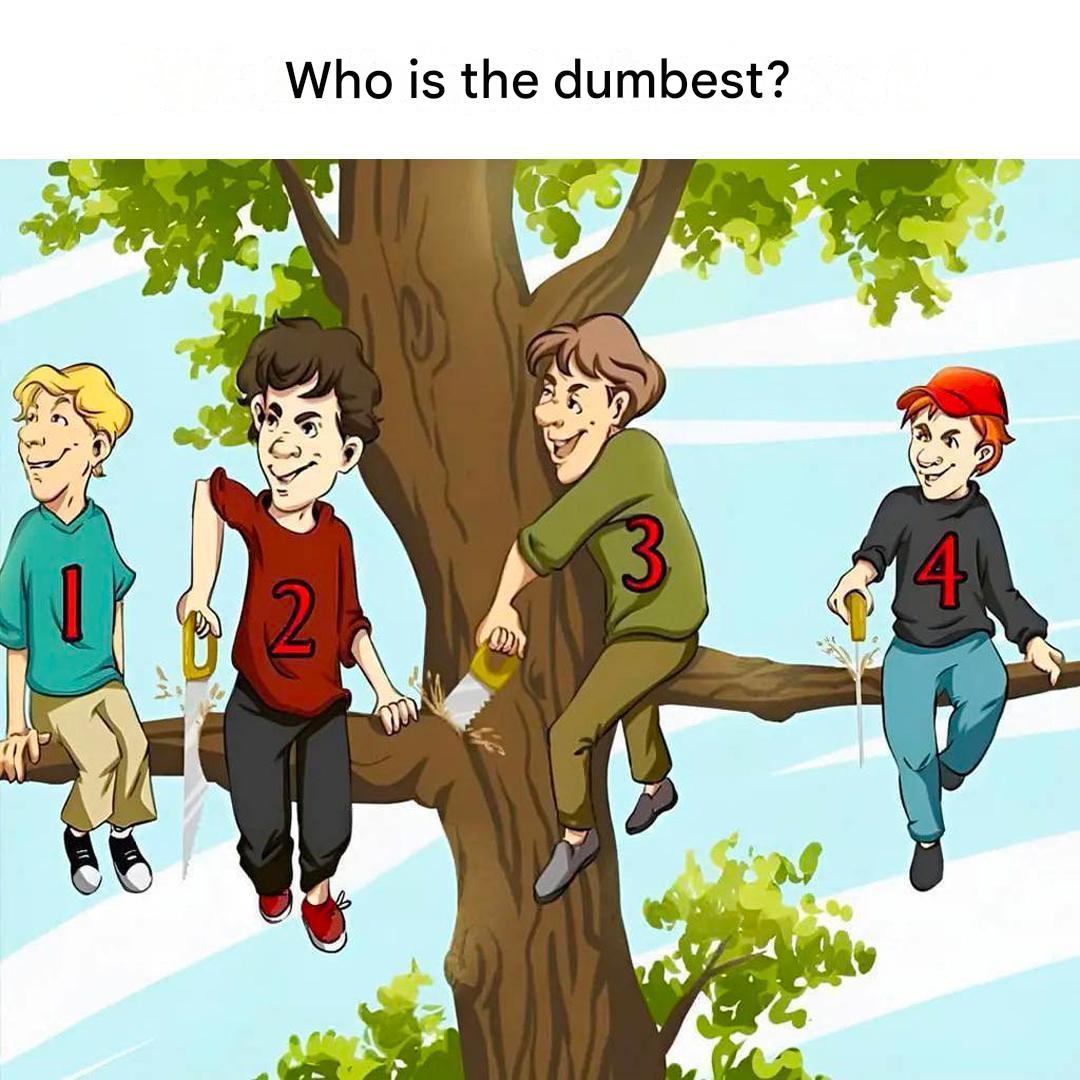
Four children in a tree, a saw, and suddenly, doubt. The answer seems obvious… but it makes them hesitate. Who will make the biggest mistake?
Four children are sitting in a tree, in a peaceful setting… until a saw appears. In a matter of seconds, the scene transforms into a true visual puzzle. At first glance, the answer seems obvious. And yet, almost all of them hesitate. So, who do you think is making the biggest mistake?
Before reading on, take a moment. Visualize the scene. Trust your intuition. Who seems the most reckless?
Why does our brain race?
In a situation like this, our mind tends to act quickly. It identifies an obvious danger and jumps to an immediate conclusion. It’s a natural reflex: we are programmed to identify risks instantly.
But this challenge highlights our tendency to judge hastily. It reminds us that first impressions aren’t always the most accurate.
In the image, each child seems to be acting differently:
How often do we see “the branch we’re sitting on” without realizing it?
Accepting too many commitments to the point of exhaustion.
Do you say yes out of fear of disappointment?
Refusing to make an important decision until you weaken the situation.
Ignoring a problem in the hope that it will disappear on its own.
At the time, the action seemed harmless. In the long run, it could completely disrupt our daily lives.
This small visual challenge acts as a mirror: it highlights the difference between an impulsive reaction and a conscious decision.
What about the other children in all of this? Some may sense that another child is also making a mistake: the one who cuts the branch where a friend is sitting, or the one who watches without intervening.
This is where the exercise becomes interesting. It invites us to reflect on responsibility, inaction, and the influence of others on our decisions
