
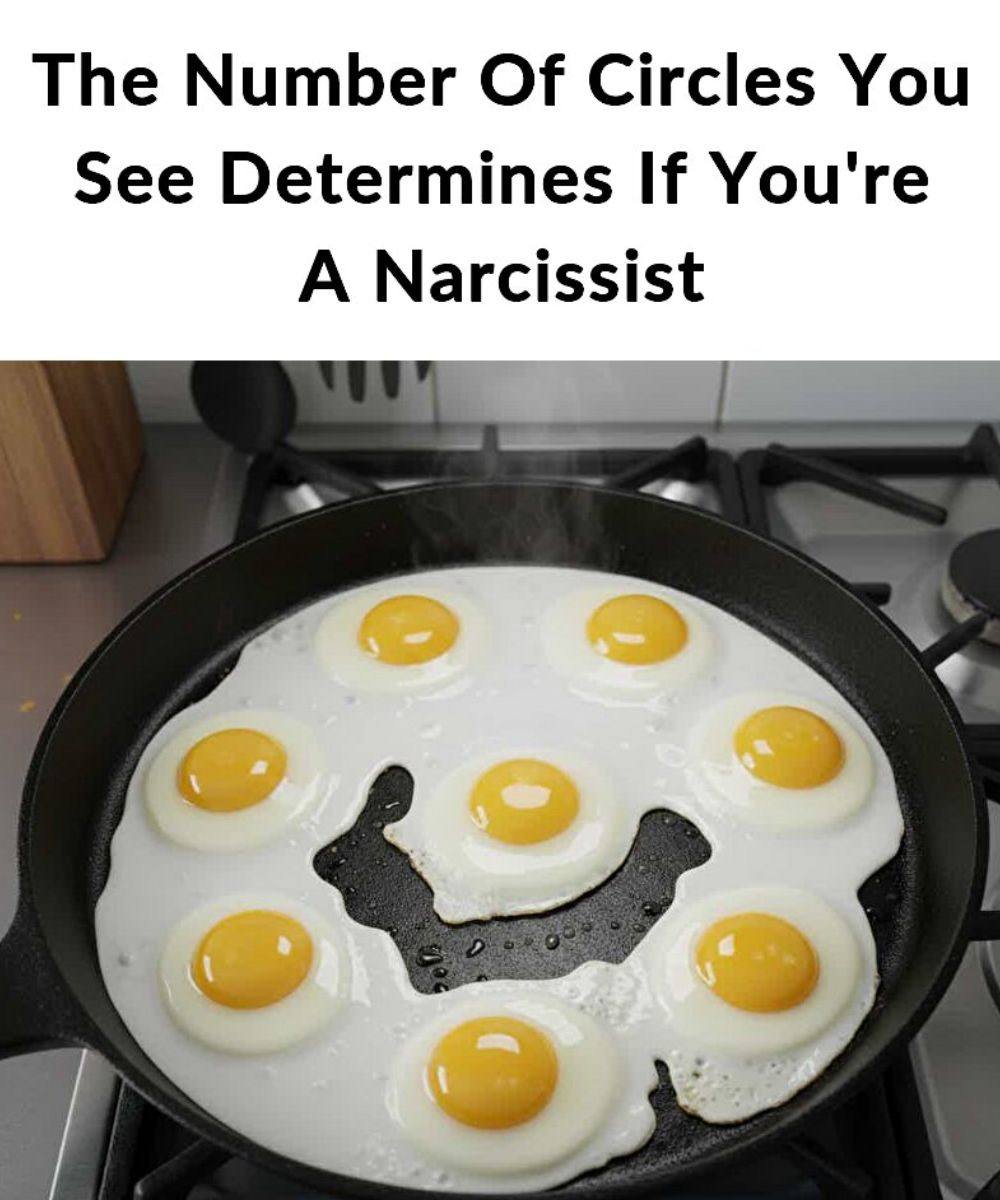
At first glance, the image looks simple: a frying pan filled with sunny-side-up eggs arranged in a playful pattern. But the bold headline above it makes a dramatic claim:
“The Number Of Circles You See Determines If You’re A Narcissist.”
Naturally, you start counting.
Do you see 8 circles?
Or 9?
Maybe 10… 11… even 13?
Before you jump to conclusions, let’s break it down.
Step 1: Count the Obvious Circles
Most people immediately see 8 bright yellow yolks. They’re perfectly round, vibrant, and impossible to miss.
But look closer.
The frying pan itself is a circle → that makes 9.
The inner rim of the pan forms another circular boundary → 10.
The stove burner underneath has circular rings → possibly 11 or 12, depending on how detailed you look.
Some even count subtle circular highlights or shapes formed by egg whites → reaching 13 or more.
So which number is “correct”?
Technically, all of them.
The Viral Claim
Online versions of this image often say things like:
- If you see 8 circles, you’re self-focused.
- If you see 9–10 circles, you’re balanced.
- If you see 11+ circles, you’re highly observant and emotionally aware.
- It sounds scientific. Structured. Convincing.
But here’s the truth:
There is 0 scientific evidence connecting circle-counting to narcissism.
What Narcissism Actually Is
In psychology, narcissism is not determined by perception games. It’s a personality trait characterized by:
- Excessive self-importance
- Need for admiration
- Lack of empathy
Clinical Narcissistic Personality Disorder (NPD) is diagnosed using structured psychological criteria — not optical illusions.
You cannot measure a complex personality pattern with an egg-counting test.
Why People See Different Numbers
Research in cognitive psychology shows that perception varies based on:
- Visual attention patterns
- Cognitive processing speed
- Context sensitivity
- Prior experiences
- About 70–80% of viewers will first identify the most visually dominant elements (the 8 yolks).
- A smaller percentage — roughly 20–30% — will scan the full frame and include background elements.
- That difference reflects attention style, not ego level.
Next PagePages: 1 2
